
A Time for Reconnection: Confessions of a Somatic Therapist Traveling in Peru
This past month, I unplugged myself from the grind of my life in Toronto and took myself on a self-directed retreat to a small village in the Andes of Peru. It was a conscious stepping away from schedules, productivity, and the familiar rhythm of hour-long sessions and a turning toward something quieter and more elemental.
For a somatic therapist, my life is not the ideal of flow and ease that people sometimes imagine. My body often tells a more complex story.
I have a long-standing pattern of holding and bracing keeping things in place, staying vigilant, making sure nothing falls through the cracks. In Polyvagal terms, this reflects a nervous system that spends a lot of time in sympathetic activation: mobilized, alert, ready to respond. Over the years, this has shown up as chronic tension in my arms and jaw, and as a steady undercurrent of nervous energy. It’s a pattern that supports competence, initiative, and responsibility. It is also one that, when left unexamined, narrows my capacity to soften, rest, and remain open in relationship.
As a business owner, therapist, and mother of three, this state is easy to normalize. Slowing down can feel counterintuitive, even unsafe. Yet as I move more fully into my wisdom years, I find myself wanting to live and work from a more spacious place, and to model this possibility for others who I want to be a good example for..
This retreat in Peru was meant as a radical reset. A deliberate interruption of the pace that keeps the nervous system mobilized. A chance to step out of the tyranny of the clock and into a different relationship with time, land, and safety.
Mentorship, Regulation, and the Relational Field
The seed for this journey was planted on my previous visit to Peru, when I reconnected with a therapist and medicine woman I had met 25 years ago at the beginning of my social work career. Our reconnection came through an unlikely coincidence a moment of synchronicity that felt meaningful enough to follow.
In a field that often prioritizes certification, supervision hours, and measurable outcomes, mentorship has become increasingly rare. Yet from a Polyvagal perspective, development happens most reliably in relationship. Our nervous systems learn safety, flexibility, and regulation not in isolation, but through repeated experiences of attuned connection.
Somatic therapy is not a technique. It is an embodied way of listening first to our own nervous system, then to the client’s, and to the relational space between us. Mentorship offers a regulating context for this learning. A mentor is not simply overseeing clinical work, but walking alongside another therapist, reflecting back patterns, blind spots, and strengths as they emerge over time.
This kind of relationship requires trust and vulnerability. It asks us to soften our defenses and allow ourselves to be seen not just in what we do well, but in what remains tender or unfinished.
Softening Through Place and Rhythm
In Peru, I’ve become more aware of how deeply my own nervous system relies on control to maintain a sense of safety. Without the usual structures of my life, the holding in my body particularly in my arms and jaw became more visible.
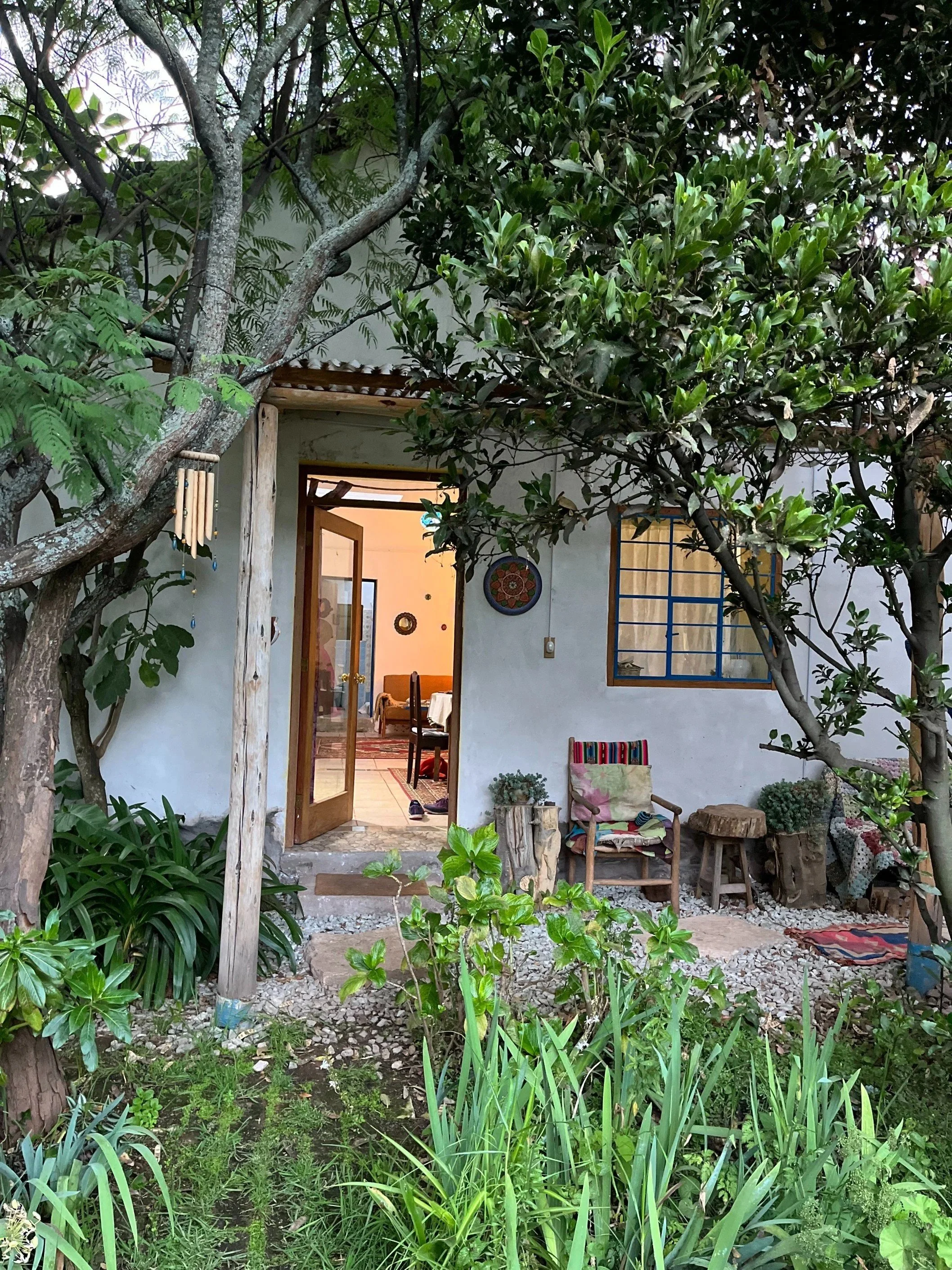
Here, my days are intentionally simple. I wake and sit in a garden, surrounded by the Andes and the sound of birds. I do very little. I sit, observe, and orient to the environment. I might draw or write a few words in my journal. Much of the work is simply allowing my nervous system to register consistent cues of safety: natural light, living plants, spaciousness, and the absence of urgency.
From a Polyvagal lens, this is not passive. It is an active re-patterning of the nervous system supporting a gradual shift toward ventral vagal states associated with connection, openness, and ease.
Time itself has become part of the work. In Toronto, my days are organized around the hour what can be accomplished, scheduled, or completed. The therapy hour often feels the most regulated because it requires presence. And yet, outside of that container, there is little unstructured time. Here, time loosens. And in that loosening, creativity, curiosity, and deeper self-awareness begin to emerge.
Learning From Plants
Many people associate Peru with ayahuasca and psychedelic plant medicine. While those traditions are present, much of plant-based healing is far more subtle.
As part of this retreat, I was guided through a “dieta” with a plant called bobinsana, traditionally used to support emotional softening and heart-based regulation. This work is not about dramatic insight or altered states. It unfolds slowly, through daily, intentional relationship with the plant.
I drink the tea three times a day and pay close attention to how it affects my body, mood, and inner landscape. This kind of work requires slowness and interoceptive awareness qualities that are foundational to somatic therapy itself. From a nervous system perspective, it mirrors low-intensity, high-consistency interventions that support integration rather than overwhelm.
From the Center, Not the Edge
As I soften and slow, a new way of being is taking shape one that comes from a quieter, more centered place.
Years ago, when I lived in Japan, I studied Aikido, a martial art based on flowing, spiral movement that originates in the hara, the body’s center. From the outside, it looks effortless. There is no forcing, no opposition. And yet, there is real power there. The movement is responsive rather than reactive, grounded rather than braced.
This is the quality I am cultivating now not just in my work, but in my life. A way of meeting what arises without gripping, without pushing, and without losing myself in the process.
Plants have much to teach us. Some work gradually and subtly, like neurofeedback. Others are more catalytic, like psychedelic medicines. Both invite us into deeper listening. What matters most is not the intensity of the experience, but the quality of attention we bring to it.
When we slow down enough to listen to our bodies, to the land, to the living world around us change doesn’t need to be driven. It can unfold, quietly and steadily, from the inside out.
Rachael Frankford MSW, RSW
